An Investor Leader Committed to Building Capability Across the Industry
Richard Hildick-Smith • Investor Leader & Managing Director, Infrastructure • SOCOTEC
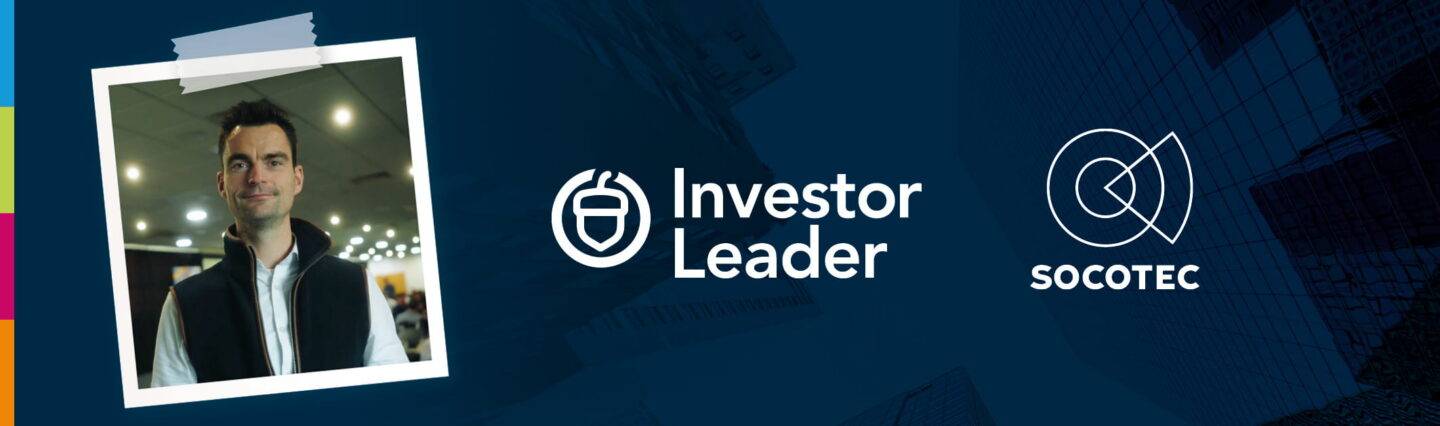
Richard’s career began where many engineers start: in design and on-site operation. Over time, his early experience managing subcontractors and engineering packages evolved into delivering increasingly complex infrastructure projects for major organisations including BP, before broadening into digital and utility infrastructure through technology-focused roles at BT Openreach.
What distinguishes Richard as an Investor Leader isn’t just the scale of the projects he’s led, it’s the way he has evolved from a hands-on mechanical engineer into a leader who invests deliberately in capability: his own, his organisation’s and the wider industry’s.
Across every step, one thing remained constant: Richard’s fascination with what he calls “cool, big stuff” – large, multi-disciplinary projects – and how teams, systems and behaviours determine whether they succeed and, essentially, whether they do so on time and on budget. From projects involving small modifications to multi-billion-pound national programmes, he’s come to believe that “projects of all scales and complexity live or die by the same fundamentals: having a clear base scope, effective communication, well led change management, team stability, the right supply chain and operational excellence.”
Today, as Managing Director of Socotec Infrastructure, Richard leads a division of 500 people, five business units and an operational footprint across the UK and Ireland. His remit spans operational delivery, commercial performance, strategic planning and growth, but at the heart of his role lies a much broader mission: building capability and capacity across the entire infrastructure sector. One of the aspects of the role he most enjoys is “working within a high performing team set-up that is continually developing and running smoothly.”
A Leader Who Builds Capability, Not Competition
As you, and indeed their shareholders, would expect, Richard is absolutely committed to achieving success for Socotec and their clients. But for him, success isn’t solely defined by who wins an individual contract or project. What drives him is the belief that the entire supply chain should be designed and strengthened as one integrated industry.
Richard supports collaboration across operators, tier ones and suppliers, not competition for competition’s sake and not guarding heard-earned knowledge. He is firm in his view that “there is plenty of work to go around which means that there can be lots of winners across the sector – we don’t need to win everything, and in fact companies that try to then don’t deliver are a big part of the problem”.
“There’s more work out there than the industry can currently deliver. We’re all trying to achieve the same things. Winning comes from building capability, not keeping everything to ourselves.”
Central to Richard’s identity is something bigger than operational leadership: he is what Fuel Learning calls an Investor Leader – someone who contributes insight, capability and perspective to uplift the wider sector, not just his own organisation.
His “Investor Leader” outlook is rooted in sharing knowledge, shaping standards and contributing to a healthier, more resilient sector. Whether he’s speaking on panels, mentoring emerging leaders, challenging assumptions in cross-industry forums or experimenting with internal “Dragons’ Den” innovation sessions, Richard invests his experience back into the wider industry, not just his own organisation including his recent contribution to a Fuel Learning senior leadership session attended by senior leaders from multiple sectors.
His approach as an Investor Leader is clear in the knowledge that the industry does need great leaders but it also needs technically competent people who are not necessarily ‘managers’. Capability should be built across the board: in management, in technical ability, in on-site competence and in experience.
“If we want the industry to deliver better, we have to invest in building better leaders – not just better projects.”
Learning and Lessons
Richard’s leadership evolution accelerated significantly during his Level 7 and MBA development journey with Fuel Learning, which he credits with transforming both how he understands himself and how he leads others. Engineering ultimately about solving problems, and in order for him to solve problems he needs to be able to better understand people and modify his leadership to suit different teams and situations. His biggest takeaways?
1. Understanding and Adjusting to Energies (Insights Discovery)
Fuel’s Insights Discovery work gave Richard language and structure around behavioural “energies” helping him understand:
- how he naturally shows up as a leader
- how his style is perceived by others
- which energies he overuses under stress
- and how to adapt his approach to different team profiles
- This has become a day-to-day tool for him.
“Engineering trains you to solve problems. Fuel taught me how to better understand people and that’s ultimately what solves the problems.”
2. Adapting His Style to Lead More Effectively
In an industry with diverse profiles, from blue engineers to red managers to mixed site crews, Richard deliberately flexes his communication, expectations and leadership depending on the people he’s working with.
- With highly analytical colleagues, he uses data, detail and structure.
- With action-driven teams, he moves fast and sets clear direction.
- With more relational personalities, he prioritises connection and shared context.
- With emerging leaders, he gives space, guidance and the chance to learn through doing.
He credits this adaptive approach as one of the most powerful outcomes of his senior leadership programme and one of the reasons he’s able to develop stronger, more autonomous teams.
3. From “fixing” to “coaching”
Perhaps Richard’s biggest shift has been resisting the instinct to dive into detail or try to fix all the issues himself, and to recognise that the way he would instinctively tackle a problem isn’t necessarily the only way, or even perhaps the best way, to resolve it. A valuable leadership lesson indeed.
“Fuel’s programme made me more conscious of when to step back. I’m still working on myself but I’m increasingly aware of the fact that my role in finding a solution and getting projects completed is as much about leveraging my team as it is my own ideas – people grow when they solve the problem not when I solve it for them.”
Operational Leadership Through a Challenging Year
This past year has tested every part of the infrastructure industry and called for calm, precision and resilience in organisations within the sector. Changes and delays to major projects like HS2 Phase 2, Lower Thames Crossing Sizewell C and rail’s CP7 scopes, regulation changes resulting in increasing challenges to high-rise construction, squeezed public budgets and broader economic pressure have all slowed activity across the sector.
For Richard and many of Socotec’s business units, this has meant a year focused on strengthening operational foundations – steadying the ship, tightening processes and supporting business units through a tougher delivery environment. Whilst many of the business units, primarily those focused on structural investigation, have had a very strong year, Richard has spent more time working with operational teams and business unit leads to ensure Socotec continue excellence of delivery in more units facing the strongest challenges. From an outsider view it might look like extra time “in the weeds” than a typical MD might prefer, but he’s unapologetic about doing the work required to stabilise the business and positioning themselves for major growth.
As he puts it:
“This year has been about operational excellence, right-sizing, and supporting our teams through a volatile market. We’re starting to see signs of growth and expecting that to continue, but ensuring the core is strong is critical and puts us in a very strong position.”
With signs of rebound across the pipeline, he is rebalancing towards strategic expansion, including targeted business development, sector prioritisation, key client partnerships and selective acquisition.
Leadership Philosophy: Clarity, People and Presence
Richard describes himself as a leader who learns continuously – from his mentors, from his teams and from the projects he delivers. Three elements define his leadership philosophy:
1. Break problems down, then build back up
His engineering roots show up in his methodical approach to complexity. He expects teams to strip issues back to first principles, document them clearly, and rebuild the path forward with logic and communication.
2. Adapt leadership to people’s profiles
Having deepened his understanding of personality types and behavioural insights, he actively varies how he leads. With analytical engineers he uses structure and precision; with more action-driven colleagues he provides clarity and directness; with detail-heavy teams he offers space and guidance.
3. Be present … really present
One of the most influential leaders in Richard’s career taught him the importance of being fully in the room. No distractions. No switching between screens. It’s something he continues to hone, and something he teaches by example.
“When you’re with your team or a team member, they should feel like they have 100% of your focus. Presence is part of leadership, not just a courtesy.”
Future Outlook
Richard is energised by what the next 12–24 months hold. With major national programmes including Sizewell C, the Great Grid Upgrade and broader infrastructure renewal gathering momentum, the opportunities for Socotec Infrastructure – and for the sector as a whole – are expanding.
His focus now is on:
- returning to growth after a stabilisation year
- strengthening capability across technical and project disciplines
- supporting clients and tier one contractors to deliver complex programmes safely and efficiently
- scaling the business sustainably through targeted strategy
- He knows the industry is cyclical but he also knows it’s on the upturn. And he wants Socotec to be positioned not just to benefit from that, but to positively influence it.
The Person Behind the Leader
Despite being a classically risk-averse engineer, Richard jokes that he has a “weakness for the occasional gamble on the horses” – an unexpected contrast he finds amusing about himself but perhaps feels less surprising knowing that Richard hails from Cheltenham. Outside work, he recharges through exercise and early-morning routines that give him structure and clarity. He’s also fiercely committed to the idea that success comes not from hours worked, but from energy, intention and balance.
Richard’s key driver is building capability not dependency. Ultimately, he aims to lead in a way that makes himself “redundant” not through absence, but confidence that the business is thriving because others are empowered, capable and equipped to deliver. His Utopia is the possibility of becoming less essential to the day-to-day operations, because that means the team is thriving.
“The best days are when I walk into a room and realise I’ve got nothing to add. That means the team is running it brilliantly and I can make better use of my time elsewhere.”
Lead by example.
Be an Investor Leader.
Learn more about Investor Leader – our exclusive initiative helping to shape the leaders of tomorrow.