
Continuous Improvement Champion
Better results come from fixing the problems that matter.
Every organisation has processes that cost more time, money and goodwill than they should: errors that keep coming back, rework, delays and customers left waiting. This programme develops the people closest to the work to find the problems worth fixing, solve them at the cause and prove the difference, using good data and AI to get there faster and with more confidence.
A Level 3 apprenticeship in applied, value-adding improvement for CI champions, team members and first-line managers, enabled by good data and AI.
Request a callbackBook a meeting

Key facts
- Qualification Level 3 Improvement Technician Apprenticeship
- Start dates Jan · Mar · May · Jul · Sep · Nov
- Duration 10 months, plus independent assessment
- Structure 5 half-day stage workshops, 10 half-day virtual Improvement and AI masterclasses, 10 one-to-one coaching sessions and 4 progress reviews
- Outcomes 1 improvement project delivering a measured business benefit at 6 stage outputs, and a portfolio of coach-checked evidence for assessment
- Funding Funded through the Growth and Skills Levy, up to the £4,000 funding band, with commercial options available


Improvement only counts when it makes a difference you can measure.
Every participant takes one real problem from their own area, chosen because fixing it matters: to customers, cost, quality, time or safety.
They work it through Define, Measure, Analyse, Improve and Control, applying practical tools at each step: process mapping, data collection, Pareto and control charts, root cause analysis, Lean tools and control plans. Each stage opens with a half-day workshop on its purpose, what good looks like and the plan, and a monthly virtual masterclass teaches the tools for the next step. Good data keeps the work honest, and AI helps participants work faster: drafting, structuring, summarising and challenging, with every output checked against the process and the data, and no confidential or personal information ever put into a prompt.
What you get back is a measurable result and someone who knows how to deliver the next one: fewer errors and less rework, time and cost taken out of the process, better service for customers, and changes that hold after the project ends.





Practical improvement skills
from the first masterclass:
- Choosing problems that matter to customers and the business
- Measuring how a process really performs, with data you can trust
- Finding and proving root causes, not just symptoms
- Making changes that hold, and showing what they are worth
WHO IT’S FOR
Anyone who wants to make
the work better, and prove it.
The people who notice the same error coming back, keep the huddle board up to date, and get asked to “sort out” a process that isn’t working. The job title varies: CI champion, team member, coordinator, team leader or first-line manager, and many have no direct reports. If the role involves improving how work flows through a team, this programme was built for it.
When this work is done well, the problems that cost the most are fixed first, at the cause. Improvements are backed by data rather than opinion, the benefit is measured, and changes hold after the project ends.
It suits people new to structured improvement who want a proven method. CI champions who need the tools and confidence to lead change without line authority. And first-line managers who want their team to solve its own problems.
Who in your organisation already sees what is costing time, money or customers, and wants to fix it? That’s your starting cohort.
REAL SKILLS FOR REAL WORK
 Prioritising
 Measuring
 Analysing
 Improving
 Sustaining
THE RETURN
Real Impact. Measured ROI.
Fuel Learning’s programmes have already delivered £60m+ in verified ROI. This one is built to do the same for you: we’ll make every penny of your Growth and Skills Levy count, and deliver a return you can measure in pounds.
Each participant runs one improvement project in their own area, chosen with their line manager for its value to customers and the business, with a named sponsor. The expected benefit is agreed in the project charter in Stage 1, measured as a baseline in Stage 2 and proved against the target in Stage 5, with the benefit confirmed in writing by the employer. Each of the six stages ends with an output that the coach checks, and the value is logged in the ROI tracker. Progress and return are reviewed with the participant and line manager at four progress reviews, starting with a project gate at week 9.


| For you, the buyer | For the line manager | For the team | For the department | For the participant |
|---|---|---|---|---|
| A measured, employer-confirmed improvement from every participant, a portfolio of evidence built on real work, and a levy spend you can defend line by line in any budget review. | A team member who brings problems with data and solutions with evidence. The ROI tracker shows exactly what has improved. | Fewer workarounds and less rework, clearer standard ways of working, and a colleague who involves them in fixing their own processes. | Processes that are measured, controlled and documented, improvements that hold, and a growing pool of people who can lead the next project. | A Level 3 qualification, a complete improvement project with their name on it, confidence with data, Lean tools and AI, and a portfolio that shows exactly what they can do: the kind of development that makes good people stay. |

ROI that continues long after the programme ends
The control plan keeps the improvement in place week after week. The standard work stays in use after the project closes. And the participant keeps spotting the next problem worth solving, and knows how to solve it. The programme has an end date. The ROI doesn’t.
THE PROGRAMME CYCLE
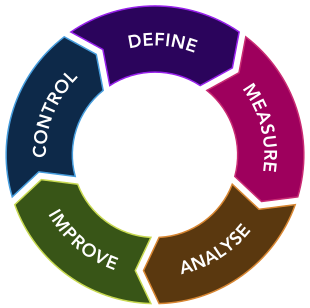
Define, Measure, Analyse,
Improve, Control. That’s how businesses thrive.
Define, Measure, Analyse, Improve, Control runs through the whole programme. Each participant takes one real problem from their own area, chosen for the difference fixing it will make, through all five stages: scoping it, measuring it, proving the cause, testing the fix and making it stick.
Each stage opens with a half-day workshop on its purpose, what good looks like and the plan. Every month, a virtual masterclass teaches the improvement tools for the next step, with the data and AI skills that support them, and a one-to-one coaching session gives feedback on the participant’s own work, teaches what they need next and agrees what to apply before the next session.
The project runs once, start to finish, over ten months, delivering a measured result while building the evidence participants need for independent assessment.
APPLICATION CYCLE
One project, five stages,
always focused on real work
and a real result.
Six stages over 43 weeks, combining five half-day stage workshops, ten monthly half-day virtual Improvement and AI masterclasses, ten one-to-one coaching sessions and workplace application.
Each stage ends with an output that adds to the participant’s portfolio: a signed charter, baseline data, verified root causes, a pilot and business case, a control plan with results, and finally an A3 report with employer benefit sign-off. A project gate at the first progress review (week 9) confirms the project is the right size before work goes further. The final stage prepares participants for assessment through an assessment workshop, a support call and a readiness review.
THE PHASES
1. Define
Choose a problem that matters to customers or the business, agree the expected benefit with a sponsor, and scope it.
2. Measure
Plan the data, check it can be trusted, and set the baseline.
3. Analyse
Find the patterns and prove the root cause with data.
4. Improve
Pilot solutions using Plan Do Check Act, then build the business case.
5. Control
Put standard work and a control plan in place, then prove the benefit.
My programme helped me improve my delegation skills and cross-functional communication, which is now saving 20% of my time – that’s a full day of work every week!
Jennifer Diniz, Assistant Portfolio Data Manager for UKIE & Fuel Graduate · Nomad Foods
What it costs. What it takes.


HOW WE DELIVER
Delivery that fits.
Flex, Focus, Fusion. We offer the choice of three delivery models – so we can build the perfect programme to suit your precise needs, cohort size and preferred learning environment. Three delivery models, one decision: how do you need it delivered?
-

Join an open programme
Maximum flexibility: any cohort size, ready-made intake dates, and participants learning alongside people from other industry sectors.
-

Built for you
A closed cohort, tailored to your organisation: your language, your systems, your challenges as the working material.
-

The best of both
Flex and Focus combined: open, flexible workshops sitting alongside closed workshops targeted at your organisation.
GETTING STARTED
From meeting to launch
in three simple steps.
-

A scoping meeting
Thirty minutes with our team. We map the roles and teams that fit, size the cohort, confirm your levy position and agree what success looks like: the numbers you’ll want to report upward.
-

We build the cohort
We handle it all. Eligibility, funding, paperwork, onboarding and manager briefings – the only admin required from you is signing off.
-

They launch
We have new cohorts starting every two months. You will see each project’s signed charter and starting point at your first progress review.
0
Half-day Stage Workshops
0
Half-day Virtual Improvement and AI Masterclasses
0
One-to-one Coaching Sessions
0
Measured Improvement Project with 6 Stage Outputs
Programme structure in detail
Learn it in a workshop. Apply it to your own project. Finish it with your coach. Practise to build confidence.
THE CADENCE
The programme starts with a Skill Scan four weeks before launch. It then runs through six stages over 43 weeks. Each DMAIC stage opens with a half-day stage workshop, and every month includes a half-day virtual Improvement and AI masterclass, a one-to-one coaching session and work on the participant’s own improvement project. Four progress reviews in weeks 9, 20, 32 and 40 track progress against the apprenticeship standard and ROI, with the project gate at the first review.
THE Six stages
Each stage features a half-day stage workshop · monthly half-day virtual Improvement and AI masterclass.
- Stage 1: Foundations and Define – Lean and Six Sigma principles, choosing a project for its value to customers and the business, the charter and voice of the customer. Supported by the AI skills Ask and explain, and Draft and structure.
- Stage 2: Measure – planning reliable data, process mapping and setting the baseline. Supported by the AI skills Define and check, and Summarise and map.
- Stage 3: Analyse – variation, control charts, capability and root cause analysis. Supported by the AI skills Interpret and verify, and Challenge and probe.
- Stage 4: Improve – piloting solutions, managing risk and building the business case. Supported by the AI skill Generate and compare.
- Stage 5: Control – Lean tools, standard work, error proofing, control plans and measuring the benefit. Supported by the AI skills Standardise and proof, and Report and share safely.
- Stage 6: Close – benefit sign-off, the A3 report and assessment preparation. Supported by the AI skill Rehearse and stress-test.
THE TEN COACHING SESSIONS
Ten one-to-one coaching sessions, one a month, each about an hour. Each follows that month’s masterclass: the coach gives feedback on the participant’s project work, teaches what they need for the next step, asks questions in the style of the assessment and agrees what to apply before the next session. Progress checks are handled separately at the four progress reviews. Session 10 prepares the participant for assessment
The End Point Assessment
Every apprenticeship includes independent assessment. For many learners, presenting their own project to an assessor is the part they worry about most. That’s why this programme builds the project, the evidence and the practice in from the start, so by the time assessment arrives, the project is complete and the evidence is already built.
Under the revised assessment plan for this standard, the assessment is designed by an independent assessment organisation and may take place at appropriate points during the programme. Every assessment must include at least one project, and all of the assessment outcomes must be covered.
Success earns a nationally recognised grade of Pass or Distinction: a Level 3 qualification evidenced by a real improvement project, not just an assessment score.
Where next? Progression routes
Participants finish with a Level 3 qualification, a complete improvement project from their own area, and the skills to lead the next one. For you, that means a pipeline of improvers you can keep developing and benefiting from.
Step into leadership – leading teams and performance with AI-enabled data:
• Data and AI Enabled Leader (Level 3)
Or deepen the specialism – and become the improvement expert your organisation calls on:
• Improvement Practitioner (Level 4):
And whichever route they take, Fuel alumni carry their ROI tracker record with them: documented, measured proof of the value they deliver.
Frequently asked questions
What does it cost us?
If you pay the Growth & Skills Levy, the programme is fully covered by it, up to the £4,000 funding band, with no course fees on top. Non-levy employers can access the same programme with government co-investment. One call and we’ll confirm your exact position.
How much time does it take out of the working week?
Around 8 hours of learning and application on average, which includes planned workshops, masterclasses and coaching, and work on the participant’s own improvement project.
How do you make sure the project is worth doing?
Projects are shortlisted with the line manager before the programme starts, against their likely value: customer impact, cost, time, quality or safety. The sponsor agrees the expected benefit and how it will be measured in the project charter, and this is checked at the project gate in week 9. At the end, the employer confirms the benefit in writing.
What about our data in AI tools?
Safe, compliant use is trained from day one. Participants learn the legislation and standards that apply, handle data lawfully and securely, and only use AI on non-confidential material, never with identifiable data. Every output is checked before it’s used, and AI never decides the priority of a requirement. If your organisation restricts certain tools, the programme adapts to the ones you’ve approved.
We use Microsoft Copilot / we don’t allow ChatGPT. Does the programme still work?
Yes. Asking a clear question, checking outputs against the data and knowing when human judgement must take over are skills that work with any tool. We train on what your people can actually use at their desks.
Do participants need to be managers?
No. The programme is built for people who improve processes, with or without direct reports. Each project has a named sponsor, and influencing without authority is taught from the first stage.
What does the line manager have to do?
A short briefing at the start, help choosing the project, sight of the ROI tracker and progress reviews as results land, and the final decision that their apprentice is ready for assessment. Each project also needs a sponsor who can approve changes and confirm the benefit in writing; this can be the line manager.
What if the project doesn’t work out?
Projects are agreed before the programme starts and checked at a project gate at the first progress review in week 9. If a project is too big, too small or blocked, it is re-scoped or swapped for another from the shortlist.
What if we invest in them and they leave?
Development is one of the biggest drivers of retention, and people who are invested in stay. As work-based improvements, they remain yours even if they choose to leave.
Who is eligible?
Anyone employed in England, aged 16 or over, in a role that fits the standard. Prior qualifications rarely block enrolment, and English and maths requirements follow the current funding rules. We check all of this for you before anyone commits.
How many people do we need to enrol?
Cohorts work at any size, from a handful of CI champions in one area to a rolling intake across the organisation. Larger cohorts increase the return: projects can target linked processes, good practice spreads across teams, and the ROI tracker rolls everything into one report you can put in front of the board.
When can they start?
We have new cohorts starting every two months: January, March, May, July, September and November.
-
Value first
Every project is chosen for the difference it will make, and the benefit is measured and confirmed by the employer.
-
One real project
Each participant takes one problem from their own area through all five DMAIC stages, with monthly one-to-one coaching.
-
AI with judgement
Decisions based on good data participants have checked, with AI used to work faster and every output verified.
Not quite the right fit?
We have a range of programmes suitable for all levels of your organisation. If our Continuous Improvement Champion programme isn’t quite right for you, you may be interested in one of our programmes below.






Take the next step
Request a callback and a member of the Fuel team will talk you through our Continuous Improvement Champion programme, answer any questions you have, and show you how it will build confident improvers who deliver measurable results across your organisation.
Ready to see the difference
your people can make?
FIND WHAT MATTERS • PROVE THE CAUSE • FIX THE PROCESS • SHOW THE VALUE