
Leading Operational Excellence
Most improvement projects don’t fail on the tools. They fail on the people, and on what happens after the project ends.
Your organisation relies on the people who make improvement, operational excellence and change their specialism. This Level 5 Improvement Specialist apprenticeship develops them to find the problem, prove the cause and make the fix stick: leading improvement aligned to business goals, applying lean, project and change tools with real data rigour, and building improvement capability in everyone around them.
Request a callbackBook a meeting



Key facts
- Qualification Level 5 Improvement Specialist Apprenticeship, plus CMI Chartered Manager status (CMgr)
- Start dates Every two months: January, March, May, July, September and November
- Duration 15 months, plus a 3-month End Point Assessment
- Structure 6 modules across 10 face-to-face workshop days, with 6 virtual Tool Pitstops, 6 one-to-one leadership coaching sessions, a programme-long improvement simulation, technical and leadership progress reviews and a mock EPA assessment centre
- Outcomes A portfolio of measured improvements on live processes, each one baselined and logged in our Fuel ROI calculator
- Funding Funded through the Growth and Skills Levy, up to the £9,000 funding band


Great leaders never stop improving.
This is continuous improvement training with a leadership edge. Every workshop is face-to-face and hands-on, with no PowerPoint. Participants see each tool working in a real workplace context, through games and practical activities, before it gets a technical name.
Applied AI is built into the toolkit: participants use the assistant your organisation has approved to analyse feedback, explore data, challenge root cause thinking and draft control plans, then check every output against the evidence. What you get back is a specialist who leads improvement through other people: projects chosen for commercial value, root causes proven with data, change that people adopt and controls that stop the problem coming back. And they build that capability in others, so improvement spreads beyond a single project.

Practical improvement skills
from the first workshop:
- Choosing improvement work that creates commercial value
- Proving root cause with data, statistical tools and Applied AI
- Leading the people side of change, and training others
- Controlling and sustaining improvement so it lasts
WHO IT’S FOR
The people who lead
your improvement.
The people who run the improvement project, facilitate the kaizen, analyse the process, coach the team and answer for whether the change stuck. The job title varies: continuous improvement lead, operational excellence specialist, change or transformation lead, process improvement manager or operations manager. If the role involves leading improvement across teams or functions, influencing stakeholders and coaching others, this programme was built for it.
It suits people who want the statistical depth and leadership skills for bigger, cross-functional projects, and specialists ready to coach and train others: an operational excellence programme built around the problems they already own.
Who in your organisation leads or supports improvement, operational excellence or change? That’s your starting cohort.
REAL CI SKILLS
 Selecting
 Mapping
 Analysing
 Solving
 Coaching
 Sustaining
THE RETURN
Validated data. Measured return.
Fuel Learning’s programmes have already delivered £60m+ in verified ROI. Our Leading Operational Excellence programme is built to do the same for you: we’ll make every penny of your Growth and Skills Levy count, and deliver a return you can measure in pounds.
Every improvement is built on your live operation: your processes, your teams and your priorities. A CI maturity assessment baselines the starting point across self, team and organisation, and is re-assessed at the end. Participants log every measured gain in Fuel ROI, and we review the return with you as it builds. Real work. Real results. Real return. From day one.


| For you, the buyer | For the line manager | For the team | For the department | For the participant |
|---|---|---|---|---|
| Levy invested in live improvement projects, with gains tied to commercial value and evidenced in EBIT. | A specialist who brings a business case before a solution, proves the cause before spending money on a fix, and builds control plans so problems don’t come back | Improvement done with them rather than to them, clear training on new ways of working, and a coach who builds their own improvement skills. | Processes analysed end to end, variation understood and controlled, and improvement deployed in line with strategy rather than as isolated projects. | The confidence to lead, drive change and champion CI across the business, whilst earning a Level 5 qualification and CMI-backed recognition. |

ROI that continues long after the programme ends
Control plans keep problems from coming back. The people they’ve trained keep improving their own work. And the specialist keeps scaling what works beyond the project that proved it. Developed specialists stay longer, so the expertise you invest in is the expertise you keep. The programme has an end date. The ROI doesn’t.
THE IMPROVEMENT CYCLE
Select, Solve, Sustain.
That’s how businesses thrive.
We build specialists who lead improvement that creates value and lasts. The programme runs as six modules, roughly eight weeks apart, alongside a programme-long simulation that takes one improvement from opportunity to sustained result. Between modules, leadership coaching, coaching tasks and technical progress reviews put every tool to work on the participant’s own problems before the next one arrives.
Every module is followed by coaching tasks that apply the learning to the participant’s own work, so the tools are used on real problems, not just practised.
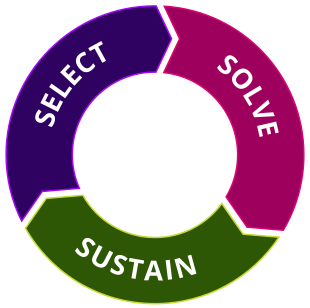
-

Select
Choose the improvement that matters: link it to business goals and commercial value, listen to the customer, and build the business case.
-

Solve
Map the value stream, gather the right data, prove the root cause with statistical tools, and lead the people through the change.
-

Sustain
Control the process so the problem doesn’t come back, transfer the knowledge, and scale what worked beyond the original project.
Six modules, each followed by coaching tasks and a technical progress review.
Every module builds on the last, from choosing the opportunity to sustaining the result, so participants finish having taken a complete improvement through every stage. Alongside the technical tools, every module builds the leadership that makes improvement land: trust, stakeholder engagement, coaching and leading people through change.
The programme closes with a mock EPA assessment centre, so the professional discussion and case-study examination are familiar long before the real thing.
THE FOUR PATHWAYS
1. Workshop pathway
Six modules across ten face-to-face days, each with a virtual Tool Pitstop.
2. Leadership pathway
Six one-to-one leadership coaching sessions and leadership progress reviews.
3. Technical improvement pathway
A six-stage improvement simulation with expert technical progress reviews.
4. Evidence and EPA pathway
A portfolio built from coaching, simulation and review evidence, tested at a mock EPA assessment centre.
The six workshops.
What it costs. What it takes.


The models I learned on my programme, allowed me to implement a project which increased our quality and has led to a 29% increase in revenue on one particular account.
Heather Sanders, Operations Director & Fuel Graduate · SOCOTEC
HOW WE DELIVER
Delivery that fits.
Flex, Focus, Fusion. We offer the choice of three delivery models – so we can build the perfect programme to suit your precise needs, cohort size and preferred learning environment. Three delivery models, one decision: how do you need it delivered?
-

Join an open programme
Diverse, collaborative and flexible. Your people learn alongside operational leaders from other organisations and sectors, with tailoring at coach level.
-

Built for you
A closed cohort, tailored to your organisation. Your language, your systems, your challenges as the working material.
-

The best of both
Flex and Focus combined: open, flexible workshops sitting alongside closed workshops targeted at your organisation.
GETTING STARTED
From meeting to launch
in three simple steps.
-
A scoping meeting
Thirty minutes with our team. We map the roles that fit, size the cohort, confirm your levy position and agree what success looks like.
-
We build the cohort
We handle eligibility, funding, paperwork, onboarding and manager briefings. All you do is sign off.
-
They launch
New intakes start every two months. After a short assessment and benchmarking, your leaders go straight into their first workshop.
0
Face-to-face workshop days
0
Virtual Pitstops
0
Leadership Coaching Sessions
0 +
Access to over 30 additional Elective Modules
Programme structure in detail
Learn it hands-on in a workshop. Refresh it in a Tool Pitstop. Apply it in your own work. Prove it in the simulation.
THE CADENCE
The programme starts with a Skill Scan, onboarding and an initial technical diagnostic, then runs six modules roughly eight weeks apart. Each module opens with a 90-minute virtual Tool Pitstop, followed by one or two face-to-face workshop days. Technical progress reviews run every eight weeks, leadership coaching runs alongside, and separate leadership progress reviews track development. A technical re-assessment, mock EPA assessment centre and readiness reviews prepare participants for the End Point Assessment.
On completion, participants gain the Level 5 Improvement Specialist Apprenticeship and CMI Chartered Manager status (CMgr).
The six modules
- Module 1 – Leading Improvement Outcomes (2 days) – trust, professionalism and stakeholder rapport; working across functions; presenting proposals and handling challenge; then the commercial case for improvement: project selection and scope, voice of the customer, Quality Function Deployment, the business case and benefits realisation.
- Module 2 – Build the High-Performing Team (1 day) – team development stages, motivation and situational leadership, coaching models, process thinking and data-driven decisions, and engaging stakeholders to drive results.
- Module 3 – Optimise the Value Stream (2 days) – Lean thinking and its culture, value stream and process analysis, DMAIC, 8D and policy deployment, TRIZ and the Pugh matrix, benchmarking; then failure mode avoidance, designed experiments, root cause analysis and deciding from evidence.
- Module 4 – Lead the Change (2 days) – change planning and readiness, influencing strategies, deploying improvement across the organisation, reinforcement and communication; then designing, delivering and reviewing workplace training, including a live 35–40 minute training session delivered to Level 4 delegates, recorded as evidence for the End Point Assessment.
- Module 5 – Drive Performance Through Control (2 days) – data collection planning, statistics and confidence intervals, stability and normality, measurement system analysis and process capability; then root cause analysis, Statistical Process Control and hypothesis testing, linking each tool’s output into the next.
- Module 6 – Sustain the Performance (1 day) – control and reaction plans, prevention controls, knowledge transfer, replicating and scaling improvement beyond one project, and final EPA preparation.
THE COACHING AND REVIEW SESSIONS
One-to-one leadership coaching runs throughout the programme, separate from the progress reviews. Coaching tasks after each module apply the learning to the participant’s own improvement work: trust and stakeholder engagement, inclusive working, relationship mapping and more.
THE ELECTIVE MODULES
Alongside the core programme, participants get full access to 30+ FuelUP elective modules across Finance & Governance, Change & Innovation, People Management, Operational Skills, Strategy & Business Acumen, and Leadership & Personal Development.
THE DIGITAL LIBRARY AND THE SHOWCASE
A full suite of online training content, created and curated by Fuel Learning, available 24/7, so every skill from every workshop is on tap at the moment it’s actually needed. Scheduling runs through the FuelHub or a dedicated Fuel Learner Manager, and the Showcase closes the programme: measured ROI presented to senior stakeholders.
Tool Pitstops, the evidence platform and the mock EPA
A 90-minute virtual Tool Pitstop opens every module. Throughout the simulation, participants upload documents, analysis, answers, video evidence and reflections to the simulation evidence platform, tagged to the standard and reviewed with expert feedback. The mock EPA assessment centre includes a mock case-study examination, a simulation showcase and a mock professional discussion.
Where next? Progression routes
Participants finish with a Level 5 qualification, the statistical and leadership depth to lead complex improvement, and the ability to build improvement capability in others. For you, that means improvement capability you can keep developing and benefiting from.
Step up to senior leadership – leading service and organisational improvement:
Service Focused Leader (Level 6)
Or lead AI-enabled improvement:
AI Transformation Leader (Level 5)
And whichever route they take, Fuel alumni carry their Fuel ROI record with them: documented, measured proof of the value they deliver.
The End Point Assessment
The End Point Assessment (EPA) is where participants showcase everything they’ve learned and prove they’re ready to lead improvement. It’s carried out independently by Academy4PM and leads to a nationally recognised grade of Pass, Merit or Distinction.
- Case-study examination: eight short case studies, each with a data set to analyse in Excel or Minitab, covering topics such as sampling, measurement system analysis, capability, hypothesis testing, regression and statistical process control. Four hours, open book, 10 multiple-choice questions per case study.
- Professional discussion: a two-hour conversation with the assessor, with a technical expert from your organisation present, underpinned by a portfolio of evidence built from real work throughout the programme. The portfolio includes a recorded 35–40 minute training session the participant designs and delivers.
Participants must pass both methods. A Distinction in both earns an overall Distinction; Merit or above in both, or a Distinction and a Pass, earns a Merit.
Frequently asked questions
What does it cost us?
If you pay the Growth and Skills Levy, the programme is fully covered by it, up to the £9,000 funding band, with no course fees on top. Non-levy employers access the same programme with government covering 95% of the cost. One call and we’ll confirm your exact position.
Can we use our Growth and Skills Levy for continuous improvement training?
Yes. Leading Operational Excellence is a Level 5 Improvement Specialist apprenticeship, so the training your improvement and operations leaders receive is funded through your Growth and Skills Levy, up to the £9,000 funding band. That covers the six workshops, the Pitstops, coaching and reviews, and access to 30+ FuelUP elective modules.
What continuous improvement tools will participants learn?
The full improvement toolkit, applied to live processes: DMAIC, Lean and value-stream mapping, root-cause analysis, statistical process control (SPC), hypothesis testing, experimentation and failure-mode avoidance, plus the control and reaction plans that hold the gain. Every tool is taught in a workshop, practised in a Pitstop and applied to a real improvement project.
How much time does it take out of the working week?
Around six hours a week of off-the-job learning, built into working hours: ten face-to-face workshop days, six virtual Tool Pitstops, leadership coaching, progress reviews, simulation work, and coaching tasks applied to the participant’s own improvement work.
What about our data in AI tools?
Applied AI is used inside the improvement work, not as a shortcut around it. Participants never put confidential, personal or commercially sensitive data into tools that aren’t approved for it, and every AI output is checked against the data and the process before it’s used. AI can speed up the analysis; the specialist proves the cause. If your organisation restricts certain tools, the programme adapts to the ones you’ve approved.
We use Microsoft Copilot / we don’t allow ChatGPT. Does the programme still work?
Yes. Participants use whichever assistant your organisation has approved, whether that’s Copilot, Claude or ChatGPT. Analysing feedback, testing a root cause and checking AI output against the evidence are skills that work with any tool.
What qualifications will participants get?
The Level 5 Improvement Specialist Apprenticeship and CMI Chartered Manager status (CMgr).
What does the line manager have to do?
A short briefing at the start, sight of the Fuel ROI calculator as results land, and the final decision that their apprentice is ready for assessment. We handle the rest, including all scheduling if they prefer.
What if we invest in them and they leave?
Development is one of the biggest drivers of retention, and people who are invested in stay. The improvements they make are work-based, so they remain yours even if the participant chooses to leave.
Who is eligible?
Anyone employed in England, aged 16 or over, in a role that fits the standard. Prior qualifications rarely block enrolment. We check all of this for you before anyone commits.
How many people do we need to enrol?
Cohorts work at any size, from a handful of improvement specialists to a rolling intake across sites. Larger cohorts increase the return: specialists share methods, improvement is deployed consistently across teams, and capability multiplies as they train others.
When can they start?
We have new Level 5 cohorts starting every two months: January, March, May, July, September, November.
-
Learn by doing
Face-to-face, hands-on workshops where every tool is practised in action.
-
The full toolkit
Statistical rigour, Applied AI and leadership of people, learned together.
-
EPA-ready
A mock case-study exam and professional discussion, so the EPA is familiar before it arrives.
Not quite the right fit?
We have a range of programmes suitable for all levels of your organisation. If our Level 5 Leading Operational Excellence programme isn’t quite right for you, you may be interested in one of our programmes below.
-

-

-

 Growth and Skills Levy Funded
 Leadership

Take the next step
Request a callback. A member of the Fuel team will talk you through the Leading Operational Excellence programme, answer your questions and show you how it will drive lasting operational improvement across your organisation.
Want your improvement leaders
to deliver change that pays?
CHOOSE WHAT MATTERS • PROVE THE CAUSE • LEAD THE CHANGE • MAKE IT STICK