
Data and AI Analyst
Reports get produced every week. Very few of them change a decision.
Your operation runs on the analysis behind its decisions: the plans, forecasts and figures that show where the effort and the money go. This programme develops the analysts who produce it, using AI to clean, combine and interrogate the data, and judges them on the decisions their analysis changes, not the reports they send.
This Level 4 Data Analyst apprenticeship develops the analysts, planners and specialists behind your operational and commercial decisions, using AI to clean, combine and interrogate data.
Request a callbackBook a meeting


Key facts
- Qualification Level 4 Data Analyst Apprenticeship
- Start dates Jan · Mar · May · Jul · Sep · Nov
- Duration 17 months, plus a three-month End Point Assessment
- Structure 6 Effectiveness Workshops, 9 Data Training Sessions (with Applied AI), 12 one-to-one coaching sessions, 5 progress reviews and a Skill Scan diagnostic
- Outcomes 4 value projects, one per phase, and a nationally recognised Pass, Merit or Distinction
- Funding Funded through the Growth and Skills Levy, up to the £15,000 funding band


The analysis is the product.
The decision it changes is the proof.
From the first session, participants work on their own data, their own stakeholders and their own operational and commercial questions. In every Data Training Session they use the AI your organisation has approved to clean, query, combine and summarise data, then check every output against the source. AI does the heavy lifting; the analyst does the thinking.
Effectiveness Workshops run alongside, building the skills that get analysis used: agreeing requirements before building, working across functions, and influencing people they don’t manage. This is data analysis training built around your own operational and commercial questions, with AI used to clean, combine and check the data.
What you get back is an impact player who starts with the business question, not the data: fewer reports nobody reads, faster answers people trust.





AI-enabled data analysis skills
from the first session:
- Turning a stakeholder request into the business question behind it
- Cleaning, combining and reconciling data with AI support
- Testing AI-generated explanations and forecasts against the data
- BuildPresenting findings that budget holders act on
WHO IT’S FOR
The people whose analysis
your decisions rest on.
The people whose working day runs on email, documents, spreadsheets and deadlines. The job title doesn’t matter: coordinator, assistant, officer, executive, scheduler, receptionist, account handler. If the role involves planning, organising, reporting, responding and keeping things on track, this programme was built for it.
Done brilliantly, that work compounds: faster decisions, cleaner handoffs, retained clients, teams freed up to do their real jobs.
It suits anyone ready to move from following the process to improving it. Anyone whose productivity would be transformed by AI. Anyone you can picture leading a team in two years.
Now count how many people in your organisation fit that description. That’s your cohort, and every one of them delivers three baselined, measured improvements. The return scales with the intake.
CAPABILITIES BUILT
 Questioning data
 Combining data
 Analysing data
 Presenting data
 Forecasting with data
THE RETURN
Real Impact. Measured ROI.
Fuel Learning’s programmes have already delivered £60m+ in verified ROI. This one is built to do the same for you: we’ll make every penny of your Growth and Skills Levy count, and deliver a return you can measure in pounds.
Every value project starts with a baseline and names its decision-maker. Each one closes with a time, cost or quality figure tested against that baseline, and a record of what the decision-maker did with the findings. Results are logged in our online ROI tracker throughout, reviewed with you at five progress reviews, and brought together in one benefits tracker by the end. Real value, demonstrated, decision by decision.


| For you, the buyer | For the line manager | For the team | For the department | For the participant |
|---|---|---|---|---|
| Four value projects per participant, each with a result you can put a number on. | An analyst who agrees what’s needed before building it, brings answers rather than more data, and records what each project was worth. The ROI tracker shows exactly what their analysis has changed. | One reconciled version of the numbers, clear requirements agreed up front, and a colleague who shows others how to use AI safely and check what it gives back. | Data cleaned, documented and reconciled across sources, people data used lawfully and only in aggregated, anonymised form, and analysis tied to the commercial numbers: cost to serve, contract performance and margin. | A Level 4 qualification, real confidence with AI and data, a value portfolio built on their own work, and a track record of decisions their analysis changed. |

ROI that continues long after the programme ends
The cleaned datasets and reconciled sources keep answers quicker and more reliable every week they’re used. The benefits tracker keeps measuring the changes the analysis drove. And the analyst keeps starting with the question, checking what AI gives back, and putting a defensible number on every finding. Developed specialists stay longer, so the expertise you invested in is the expertise you keep. The programme has an end date. The ROI doesn’t.
THE PROGRAMME CYCLE
Predict. Prove. Improve.
That’s how businesses thrive.
We build analysts whose work changes decisions. What we don’t do is teach AI tools in isolation, or measure success by the number of reports produced. Every session is tied to a real question from the participant’s own work, and every project names the person who will act on it.
The programme runs as four value projects, one per phase, each wider in scope than the last: from the participant’s own role, to where the operation’s effort goes, to the commercial numbers, and finally the EPA project. Each one applies that phase’s workshops and Data Training Sessions to a live question before the next phase begins.
Every value project is built on the participant’s real work.
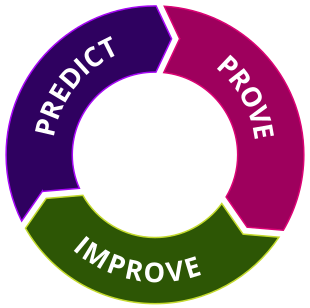
-

Predict
Pick a real question, set the baseline, and predict the value you expect it to deliver in time, cost or quality.
-

Prove
Do the analysis, with AI as an assistant and every output checked against the source. Then prove what actually happened against the baseline, and record what the decision-maker did with it.
-

Improve
Improve the analysis or the action based on the evidence, and carry the lesson into the next project.
The cycle runs four times over 17 months, once per phase, building a value portfolio of four measured projects as it goes.
The capability builds with each cycle. By the end, each participant has a portfolio built from real work, ready for the End Point Assessment.
THE FOUR VALUE PROJECTS
The programme runs in four phases, each one growing in scope and complexity.
Every value project starts with a baseline and ends with a figure tested against it, so you see the return as it lands. Alongside the data skills, every phase builds the professional effectiveness that makes analysis count: owning a workload, working across functions, influencing people they don’t manage, and handling the challenge from a sceptical budget holder. By the final phase, participants have a complete value portfolio and the project they will take into the End Point Assessment.
THE FOUR PHASES
Phase 1 Your Role & Stakeholders
What does good look like for my role and my stakeholders?
Phase 2 The Effort
Where is the effort going, and what is it worth?
Phase 3 The Numbers
The commercial numbers behind the analysis.
Phase 4 The Project:
Select and prepare the project for End Point Assessment.
My programme helped me improve my delegation skills and cross-functional communication, which is now saving 20% of my time – that’s a full day of work every week!
Jennifer Diniz, Assistant Portfolio Data Manager for UKIE & Fuel Graduate · Nomad Foods
What it costs. What it takes.


HOW WE DELIVER
Delivery that fits.
Flex, Focus, Fusion. We offer the choice of three delivery models – so we can build the perfect programme to suit your precise needs, cohort size and preferred learning environment. Three delivery models, one decision: how do you need it delivered?
-

Join an open programme
Maximum flexibility: any cohort size, ready-made intake dates, and participants learning alongside people from other industry sectors.
-

Built for you
A closed cohort, tailored to your organisation: your language, your systems, your challenges as the working material.
-

The best of both
Flex and Focus combined: open, flexible workshops sitting alongside closed workshops targeted at your organisation.
GETTING STARTED
From meeting to launch
in three simple steps.
-
A scoping meeting
Thirty minutes with our team. We map the roles and teams that fit, size the cohort, confirm your levy position and agree what success looks like: the numbers you’ll want to report upward.
-
We build the cohort
We handle it all. Eligibility, funding, paperwork, onboarding and manager briefings – the only admin required from you is signing off.
-
They launch
We have new cohorts starting every two months: January, March, May, July, September and November. Participants deliver their first measured result at the end of phase one.
0
Effectiveness Workshops
0
Data Training Sessions (with Applied AI)
0
One-to-one Coaching Sessions
0
Value Projects
Programme structure in detail
Learn it in a workshop. Practise it in a Data Training Session (with Applied AI). Apply it to a live question. Prove what it was worth.
THE CADENCE
The programme starts with a Skill Scan diagnostic and runs in four phases over 17 months. Effectiveness Workshops, delivered by professional effectiveness facilitators, set the direction for each phase. Data Training Sessions (with Applied AI), delivered by Data and AI Trainers, build the data skills that go with them. One-to-one coaching with a Data Coach turns both into a live value project in the participant’s own role, and five progress reviews track development and value along the way.
The four phases and value projects
The programme runs in four phases.
- Your Role and Your Stakeholders
- Where the Effort Goes
- The Commercial Numbers
- The EPA Project
The Predict, Prove, Improve cycle runs across the 17 months, so every workshop and Data Training Session feeds a live value project.
The six Effectiveness Workshops
- Work Better: The Role of Analysis – moving from producing reports to answering questions: the analyst’s role in the operation, and question first, data second.
- Communicate to Influence – participants learn to influence the people they don’t manage: knowing the decision-maker and writing findings in plain English.
- Turn Operational Insight into Shared Action – agreeing requirements with the functions that will use the analysis before building it, and reading the operation the way it’s judged: how it’s measured and where the effort goes.
- Commercial Insight for Better Decisions – reading the commercial picture like a finance partner: contract performance, cost drivers and the P&L.
- Present Data Insight – presenting findings so the people who decide act on them: one chart, one message, and handling the challenge.
- Prove the Value – tracking benefits across all four value projects, and sustaining the change so the value lasts.
The nine Data Training Sessions
- Work Smarter – Excel and AI essentials, and the data lifecycle: working faster and more safely with the tools already in the role.
- Get Your Data in Shape – cleaning and validation, and logging quality issues, so the data is safe to rely on.
- Read Patterns that Inform Decisions – descriptive statistics, trends, variance and outliers: finding the signal that matters to the decision.
- Know Your People Data – labour, absence and capacity data, aggregated, anonymised and used lawfully and fairly.
- The Data That Runs Your Operations – joins and lookups, and reconciling several sources into one documented view.
- Know Your Commercial Numbers – cost to serve, and volume and margin sensitivity: putting a defensible commercial value on the analysis.
- Know Your Commercial Number – market and customers, sales and P&L forecasting, and scenario modelling.
- Telling a Story with Your Data – visual design and narrative structure that land with the people who decide.
- Predict, Prove, Improve: The Data Impact – forecasting basics, and testing the prediction against what actually happened.
THE COACHING SESSIONS
One-to-one with a Data Coach throughout the programme. Coaching is where each value project is reviewed and the evidence it leaves in the portfolio is built: choosing the question, setting the baseline, applying the skills live, and logging the measured result in the ROI tracker.
THE DIGITAL LIBRARY AND THE SHOWCASE
A suite of online training content, created and curated by Fuel Learning, available 24/7, so every skill from every workshop is on tap at the moment it’s needed. Scheduling runs through the FuelHub or a dedicated Fuel Learner Manager, and the Showcase closes the programme: measured ROI presented to stakeholders.
The End Point Assessment
Every apprenticeship finishes with an independent End Point Assessment (EPA). On this programme it isn’t a separate hurdle at the end. It’s the fourth value project with an external audience. By the time the EPA arrives, participants have already delivered, measured and evidenced three real value projects, and chosen the project they will be assessed on.
Completed over a typical three-month window after gateway, available online, and assessed by an independent assessor, the EPA has two assessment methods:
- Project with presentation and questioning. A work-based data analysis project with a real business application, completed within eight weeks of the EPA start and written up as a report of up to 3,500 words. It is followed by a 40-minute session with the assessor: a 20-minute presentation of the project, its findings and recommendations, then 20 minutes of questions.
- Professional discussion with portfolio. A 60-minute one-to-one discussion with the independent assessor, underpinned by a portfolio of typically ten pieces of evidence built during the programme. It’s a structured conversation about what they’ve done, how they did it and what it delivered.
Each method is graded Fail, Pass or Distinction, and together they earn a nationally recognised overall grade of Pass, Merit or Distinction: a Level 4 qualification backed by real, measured workplace results.
Where next? Progression routes
Participants finish with a Level 4 qualification, a value portfolio of four measured projects, and the judgement to use data and AI well. For you, that means specialist capability you can keep developing and benefiting from.
Step into leadership – leading teams, operations and results with AI-enabled data:
• Data and AI Performance Leader (Level 4)
• Service Focused Leader (Level 6)
Or lead improvement and AI adoption across the organisation:
• Leading Operational Excellence (Level 5)
• AI Adoption Leader (Level 4)
And whichever route they take, Fuel alumni carry their ROI tracker record with them: documented, measured proof of the value they deliver.
Frequently asked questions
What does it cost us?
If you pay the Growth and Skills Levy, the programme is fully covered by it, up to the £15,000 funding band, with no course fees on top. Non-levy employers pay just 5% of the cost, with the government covering the remaining 95% (and 100% for participants aged 16 to 24). One call and we’ll confirm your exact position.
CAN WE USE OUR GROWTH AND SKILLS LEVY FOR AI TRAINING?
Yes. The Level 4 Data Analyst apprenticeship is funded through your Growth and Skills Levy, up to the £15,000 funding band. That covers the six Effectiveness Workshops, the nine Data Training Sessions (with Applied AI) and one-to-one coaching, with AI built into the programme rather than added as a separate course.
Is the Level 4 Data Analyst apprenticeship suitable for planners and specialists?
Yes. It is built for people whose work turns data into decisions: planners, analysts, forecasters and operational or commercial specialists. Participants apply cleaning, reconciliation, statistics, forecasting and data visualisation to their own operation, use AI with every output checked against the source, and finish with a Level 4 Data Analyst apprenticeship.
How much time does it take out of the working week?
Around six hours a week of learning and application, built into working hours. This includes six Effectiveness Workshops, nine Data Training Sessions (with Applied AI), one-to-one coaching and applied workplace outputs built on the participant’s own work.
What about our data in AI tools?
Safe, compliant use is trained from day one. Participants learn the law on data use and your organisation’s security policies, only use AI on people data once it’s aggregated and anonymised, and check every output against the source before it’s shared. If your organisation restricts certain tools, the programme adapts to the ones you’ve approved.
We use Microsoft Copilot / we don’t allow ChatGPT. Does the programme still work?
Yes. Participants use whichever assistant your organisation has approved, whether that’s Copilot, Claude or ChatGPT. Turning a request into a business question, checking outputs against the source and reconciling totals by hand are skills that work with any tool.
What does the line manager have to do?
A short briefing at the start, sight of the ROI tracker as results land, and the final decision that their apprentice is ready for assessment. We handle the rest, including all scheduling if they prefer.
What if we invest in them and they leave?
Development is one of the biggest drivers of retention, and people who are invested in stay. The improvements they make are work-based, so they remain yours even if the participant chooses to leave.
Who is eligible?
Anyone employed in England, aged 16 or over, in a role that fits the standard. Prior qualifications rarely block enrolment. We check all of this for you before anyone commits.
How many people do we need to enrol?
Cohorts work at any size, from a handful of analysts in one function to a rolling intake across the organisation. Larger cohorts increase the return: analysts share methods, one reconciled version of the numbers spreads across teams, and the ROI tracker rolls everything into one report you can put in front of the board.
When can they start?
We have new cohorts starting every two months: January, March, May, July, September and November.
-
AI in every session
Copilot, Claude or ChatGPT used to clean, query, combine and summarise, with every output checked against the source.
-
Four value projects
From the participant’s own role to the EPA project, each one wider in reach than the last. ROI you can verify.
-
Judged on decisions
Every project names its decision-maker and records what they did with the findings.
Not quite the right fit?
We have a range of programmes suitable for all levels of your organisation. If our Data and AI Analyst programme isn’t quite right for you, you may be interested in one of our programmes below.




Take the next step
Request a callback and a member of the Fuel team will talk you through our Data and AI Analyst programme, answer any questions you have, and show you how it will turn your analysts’ work into decisions with a measured value.
Ready to see your analysts
change decisions with data?
ASK THE REAL QUESTION • PROVE THE VALUE • CHANGE THE DECISION